Website Resources
A plethora of non-profit and governmental organizations exist to assist Dallas ISD in their transition from fossil fuels-based operations to a more sustainable model. The list of resources below is NOT exhaustive. It is a very good sampling of the resources available to us in Texas.Some of the materials from the organizations’ website have been displayed in regular font to provide the reader with a flavor of each organization’s expertise and focus. Editorial comments are in italics, like this introduction.
The Transportation Department at NCTCOG serves as the Metropolitan Planning Organization (MPO) for the 12-county Dallas-Fort Worth region. The MPO works closely with regional, state and federal partners to plan and recommend transportation projects that will improve mobility and encourage more efficient land use, all while minimizing the impact on the region’s air quality.
Dallas-Fort Worth Clean Cities is a Department of Energy Program operated through NCTCOG. DFW Clean Cities works with local transportation fleets with the mission to improve North Texas air quality through initiatives and partnerships that reduce transportation emissions, improve efficiency, and strengthen the local economy. Resources available to the public are at:
Contact:
Lori Pampell Clark
North Central Texas Council of Governments
Program Manager
(817) 695-9232
Texas Electric Transportation Resources Alliance (TxETRA)
TxETRA’s Mission is to guide and accelerate the adoption of electric transportation in all its forms in the most cost effective way providing maximum benefit to the citizens of Texas with the goal of 10 million electric vehicles and 75% of all trips to be electric propulsion by 2035.
They have electric school bus articles and videos at:
Contact:
Tom “Smitty” Smith
Executive Director
North Texas Renewable Energy Group (NTREG)
The North Texas Renewable Energy Group (“NTREG”) is a Strategically Affiliated Chapter of the Texas Solar Energy Society
NTREG Mission Statement
The Mission of North Texas Renewable Energy Group is to further the development of renewable energy, sciences and technologies with concern for the ecological, social and economic fabric of our community and state. NTREG promotes renewable energy through the exchange of ideas and information at meetings, discussion group and public and private events.
Generation180

Generation180 is a non-profit working to inspire and equip people to take action on clean energy.
Generation180’s founding was prompted by a growing realization that we are at a tipping point in America’s transition to clean energy. The convergence of macro trends across the power, commercial, finance, and political sectors, as well as the arrival of rooftop solar power and electric vehicles to the mass market, have made it possible for our generation to fundamentally change our direction. We can now dramatically accelerate the arrival of a 100% clean energy future.
Here’s where you come back into the picture: the new energy reality means you can choose to take direct action on clean energy. You can play a meaningful role—now more than ever. Your energy matters.
K12 Climate Action
Serving nearly one in six Americans, K-12 public schools can play a critical role in moving our country towards environmental sustainability. If all the schools in the U.S. were to shift to clean energy, sustainable food use, and non-fossil fuel transportation over the next decade, we will have successfully transitioned one of the largest public sectors impacting the environment. And what makes schools especially impactful is the potential for them to transition to sustainability while educating their students helping prepare youth to confront the climate challenges of the future.
K12 launched a commission to learn about the needs and opportunities for schools to move toward climate action. The commission developed an action plan https://www.k12climateaction.org/blog/climate-action-plan-2021 that considers how the education sector can mitigate, adapt, educate, and advance equity to respond and address climate change.
K12 is building a coalition of people and organizations from across the country who believe our schools will be an essential tool in the fight against climate change and want to support our schools to be a force toward climate action, solutions, and environmental justice.
Austin ISD Environmental Stewardship Advisory Committee (ESAC)
The ESAC seeks to influence AISD curriculum, instruction, and student learning; integrate sustainability guidelines into the design, construction, and operation of AISD facilities; build awareness and engagement on environmental sustainability topics; and pursue public-private partnerships and other funding mechanisms. The purview of the ESAC may include, but is not limited to, the following resource areas:
- Energy conservation and renewable energy
- Water conservation and quality
- Sustainable transportation
- Outdoor air quality and climate change
- Indoor air quality and environmental health
- Environmentally responsible purchasing
- Waste minimization, recycling, and composting
- Sustainable food and outdoor spaces
The Environmental Stewardship Envisioning Committee (a precursor to the current ESAC) began as a grassroots effort in the fall of 2008. The ESAC was instrumental in the development of the district’s Environmental Sustainability Policy District Policy [Local] that was adopted in 2011 and the creation of a sustainability and environmental stewardship staff position in 2014.
Boulder Valley School District
Boulder Valley School District builds energy efficient schools with solar PV power generation.
Schools throughout Colorado use electric school buses:
Other Schools: Hayden School, West Grand School, Grandby Schools,Durango Schools, Steamboat Springs, Kremling. All of these school are listed by the website below.
Rocky Mountain Institute (RMI)
WHO WE ARE
RMI is an independent, non-partisan, non-profit organization of experts across disciplines working to accelerate the clean energy transition and improve lives. Since our founding in 1982 by Amory Lovins, RMI’s chairman emeritus, we have grown to 300 staff working on four continents with a global reach and reputation.
Our Mission: Transforming the global energy system to secure a clean, prosperous, zero-carbon future for all.
WHAT WE DO
RMI decarbonizes energy systems through rapid, market-based change in the world’s most critical geographies to align with a 1.5°C future and address the climate crisis. We work with businesses, policymakers, communities and other organizations to identify and scale energy system interventions that will cut greenhouse gas emissions at least 50% by 2030.
For nearly 40 years, RMI has utilized our unique techno-economic expertise and whole-systems thinking to publish groundbreaking research and analysis. We bring together collaborations of rare reach, range and expertise—creating unconventional partnerships and mobilizing action to drive change on the massive scale needed to combat the climate crisis.
U.S. Green Building Council
Sponsors the LEED Green Building rating system—a widely accepted and used building efficiency rating system.
Mission and vision
We’re committed to transforming how our buildings are designed, constructed and operated through LEED, because we believe that every person deserves a better, more sustainable life.
Our vision is that buildings and communities will regenerate and sustain the health and vitality of all life within a generation. Our mission is to transform the way buildings and communities are designed, built and operated, enabling an environmentally and socially responsible, healthy, and prosperous environment that improves the quality of life.
Today people know that if they are in a LEED-certified building they are using less energy and water, avoiding waste, saving on maintenance costs, improving indoor air quality, offering comfort to their occupants, and creating less environmental burden on their community. They also know that they are in a building that enhances health and wellness. Now green building has grown into a trillion-dollar industry, and LEED has become the most widely used green building program in the world.
LEED Schools
Two LEED Certification programs are available:
- LEED For Building Design and Construction: Schools—construction or renovation of buildings dedicated to K-12 learning.
- LEED for Operation and Maintenance: Schools—Day-to-day operations and maintenance for buildings dedicated to K-12 learning.
THE CENTER FOR GREEN SCHOOLS
USGBC launched the National Green Schools Campaign alongside partners at the 2007 Clinton Global Initiative, committing to a vision of green schools for every child. That same year, USGBC launched the LEED for Schools rating system, which provided a leadership standard for better, healthier school buildings.
After listening to and learning from school leaders around the country, USGBC founded the Center for Green Schools in 2010, broadening its foundational work in the green building movement to encompass topics and issues important to schools and the people in them every day: teachers, students, staff, and parents. Since that time, The Center for Green Schools has focused on the highest impact opportunities to accelerate a global green school movement.
Through its educational resources, professional learning networks, and industry-recognized tools, The Center for Green Schools equips supporters to educate students about global sustainability and deepens learning by acting in their communities to
- Find tools to act at their school
- Educate for sustainability
- Connect to professional networks
- Make the case for green schools
CHPS Programs
(Collaborative for High Performance Schools)
CHPS oversees the nation’s first green building rating program especially designed for K-12 schools. Schools can self-certify their school through CHPS Designed™, a self-certification program, or pay a fee for a third-party verification of their high performance school through CHPS Verified™.
CHPS is leading a national movement to improve student performance and the entire educational experience by building the best possible learning environments. To achieve this goal, we maintain the nation’s most authoritative criteria for healthy, environmentally sustainable, cost effective school buildings.
The CHPS Criteria for new construction and major renovation is designed to help school districts in every community across the country reduce operating costs; achieve higher student performance; increase daily attendance; retain quality teachers and staff; be energy, water and resource efficient; and minimize environmental impact.
At CHPS, we know that collaboration across stakeholders combined with locally appropriate standards and best practices are the most effective means to achieve high performance buildings. That’s why our approach is to offer criteria adapted to specific geographic areas in partnership with an organization located in the state or area. We facilitate this process by starting with a national set of standards developed by our National Technical Committee, called the Core Criteria, that forms the basis for new adaptations and updates of state and regional CHPS Criteria.
Dallas ISD Policy for construction of new buildings is found in CL(LOCAL) – BUILDINGS, GROUNDS, AND EQUIPMENT MANAGEMENT
The LEED Silver certification target for new schools is an extremely LOW energy efficiency requirement for the school.
Action for the Climate Emergency
OUR MISSION, VISION AND VALUES
ACE educates, inspires and supports young people to lead the fight for their future. We ensure they have everything they need to understand the science and advocate for solutions to the climate emergency.
We envision a world in which a global movement, rich in youth leadership, has turned the tide on climate change. We believe an equitable, biodiverse, carbon neutral future is still within reach if we, the people, compel our leaders to act.
We believe in justice and equity in climate actions.
We believe in telling the whole truth, because young people have the right to understand the science of the climate emergency and how it is inextricably linked to the economic, social, and leadership choices we make.
We believe in the creativity and power of young people to lead the way in imagining a better future.
We believe in the courage of young people to stand up against misinformation, falsehoods and climate injustice wherever they occur.
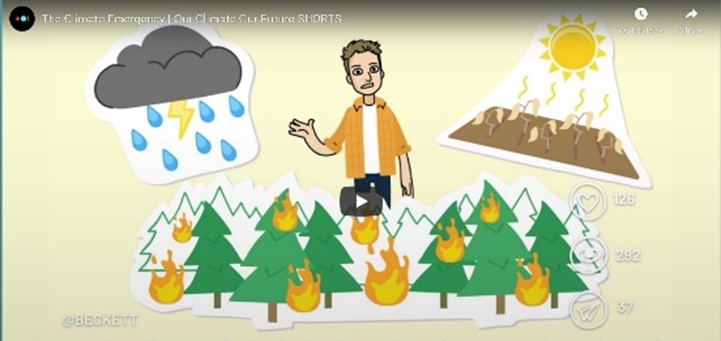
Our Climate Our Future is an ACE project.
Click the button below to view one of several project short videos:
Children’s Environmental Literacy Foundation
CELF develops and supports training programs to complement existing curricula for K-12 schools to teach students the basics of environmental sustainability. The Civic Science: Inquiry to Action is one such program.
CELF’s Civic Science: Inquiry to Action program engages students in hands-on learning to identify, analyze, and solve real-world environmental issues that impact their schools, neighborhoods, and beyond.
Students for Climate Action (S4CA)
S4CA is a 501(c)(3) non-partisan climate action committee that mobilizes students to engage congress and other elected officials to act on Climate and be a part of the solution by supporting climate policies and 100% renewable energy initiatives. Through education, public acts of engagement, and community involvement, the students have the power to help control local, County, State and Federal Policy.
Schools for Climate Action
We are a non-partisan, grassroots, youth-adult campaign with a mission to empower schools to speak up for climate action. We advocate for elected officials to combat the climate crisis in order to protect current and future generations.
We help school boards, student councils, school environmental clubs, PTA’s, teachers’ unions, and school support organizations to pass resolutions that do 3 things:
- Drive a paradigm shift so people recognize climate change as a generational justice and equity issue.
- Clearly articulate the political will for all elected leaders, especially Members of Congress, to support or enact common-sense climate policies including:
- 100% clean energy transition plans that include safety nets and training for transitioning workers
- green infrastructure and technology investments that meet the urgency, scope, and scale outlined in the IPCC’s Special Report, “Global Warming of 1.5 Degrees Celsius,”
- Celebrate and expand school district responses to climate change including climate education and resiliency initiatives.
They offer sample letter to politician and school board resolutions.
 GreeningDallasISD